
When selecting bearings for rollers, understanding the difference between a ball and roller bearing system is essential for optimal performance, cost-efficiency, and equipment longevity. Whether you’re sourcing parts for conveyor systems, packaging machines, or heavy-duty transport rollers, choosing the right rollers and bearings combination is a decision that directly impacts motion precision, load handling, and wear resistance. But how do you know which is the best fit?
In this article, we’ll explore the key differences between ball and roller bearings, their mechanical behavior under various loads, and how to make informed decisions when specifying bearings for rollers across a range of industrial and commercial applications. Know More
The Basics: Ball Bearings vs. Roller Bearings
Before we get into application specifics, let’s break down the fundamental difference between these two bearing types.
Ball Bearings
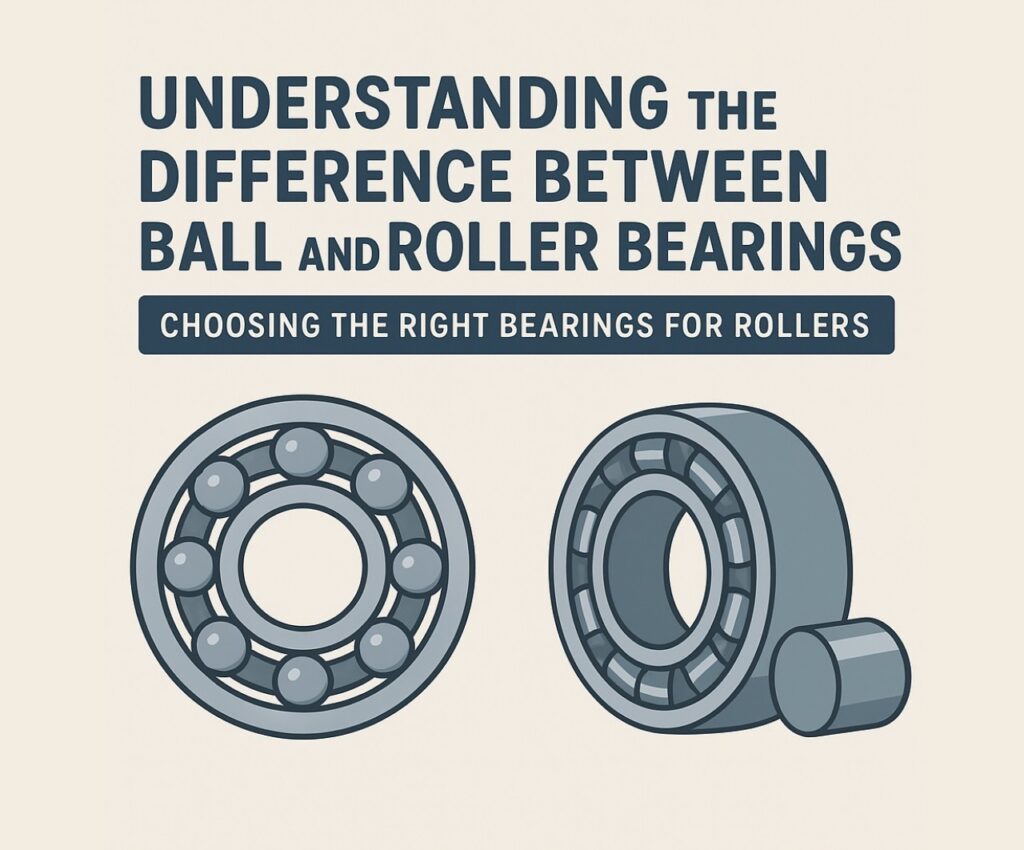
Ball bearings use spherical balls between the inner and outer races to reduce rotational friction and support radial and axial loads. They are commonly used in high-speed, low-load applications.
Roller Bearings
Roller bearings, in contrast, use cylindrical or tapered rollers instead of balls. These bearings have a larger contact area, allowing them to handle heavier loads but typically operate at lower speeds.
Both are essential components in rollers and bearings configurations, but each has distinct advantages depending on the system requirements.
Load Types and Bearing Behavior
One of the most important considerations when selecting bearings for rollers is the type and magnitude of the load the bearing will support.
| Load Type | Ball Bearings | Roller Bearings |
| Radial Loads | Excellent for moderate loads | Superior for heavy-duty radial loads |
| Axial Loads | Good for light axial thrust | Better in tapered or spherical variants |
| Shock Loads | Less resistant to impact | Higher resistance due to line contact |
| Speed Tolerance | High-speed capable | Medium to low speed, load-prioritized |
The ball and roller bearing design you choose must be optimized for your specific combination of speed, load, and duty cycle.
Bearings for Rollers: Application Examples
The application often dictates whether a ball or roller bearing will provide better results. Below are examples of bearings for rollers across common industry categories.
1. Conveyor Rollers
- Best Fit: Ball bearings
- Reason: Lightweight loads, high-speed operation, and continuous duty cycles favor low-friction, sealed ball bearings.
2. Material Handling Rollers
- Best Fit: Roller bearings (especially cylindrical or needle types)
- Reason: These systems often carry heavy loads for long durations. Roller bearings provide higher radial load capacity.
3. Textile Rollers
- Best Fit: Precision ball bearings
- Reason: Low noise, high RPMs, and minimal friction are key in textile manufacturing.
4. Agricultural Rollers
- Best Fit: Tapered roller bearings
- Reason: Equipment used in rough terrain experiences both radial and axial loading. Tapered rollers handle both effectively.
5. Automotive Timing Rollers and Tensioners
- Best Fit: Ball bearings with sealed construction
- Reason: Space constraints and high rotational speed demand compact, durable ball bearing units.
Clearly, the optimal rollers and bearings configuration varies greatly by industry and application.
Key Factors in Choosing Bearings for Rollers
Choosing the right bearings for rollers goes beyond ball vs. roller—here’s what engineers and buyers should evaluate:
1. Load Rating
- Ball Bearings: Lower contact area = lower load rating
- Roller Bearings: Line contact distributes load better = higher capacity
Use roller bearings in systems with heavy loads or high-impact duty cycles.
2. Speed
- Ball bearings offer lower friction, making them better for high-RPM applications.
- Roller bearings can overheat at high speeds if not properly lubricated.
3. Axial vs. Radial Load
- If your system experiences combined axial and radial loads (such as conveyor rollers under thrust), use tapered or spherical roller bearings.
- For pure radial loads, cylindrical rollers work well.
4. Misalignment Tolerance
- Ball bearings have limited ability to self-align.
- Spherical roller bearings offer excellent misalignment tolerance, ideal for less precise housing or shaft setups.
5. Maintenance Requirements
- Sealed ball bearings are low-maintenance and often used in sealed systems.
- Open or shielded roller bearings require periodic lubrication.
The correct ball and roller bearing choice ensures both performance and serviceability.
Engineering Specs: Ball Bearings vs. Roller Bearings
| Specification | Ball Bearings | Roller Bearings |
| Friction Coefficient | Low | Medium |
| Contact Area | Point contact | Line contact |
| Bearing Life (L10) | Moderate (depends on load & speed) | Longer under heavy loads |
| Temperature Range | Wider with proper seals/lube | Depends on material & lubrication |
| Cost | Lower upfront cost | Higher initial, longer life in some apps |
Understanding these metrics helps engineers fine-tune rollers and bearings performance to system requirements.
Specialized Bearing Types for Rollers
Depending on the system design, you may need to explore variants of traditional ball or roller bearings:
- Deep Groove Ball Bearings: Ideal for high-speed conveyor rollers.
- Needle Roller Bearings: Great for compact roller designs with high radial loads.
- Spherical Roller Bearings: Allow for shaft deflection and misalignment.
- Double-Row Ball Bearings: Used when greater load capacity is needed in a compact footprint.
- Tapered Roller Bearings: Used in conveyor drum rollers and agricultural equipment for combined load handling.
OEMs designing high-performance bearings for rollers systems should evaluate both standard and application-specific bearing types.
Common Mistakes to Avoid
❌ Over-Specifying the Bearing
Using a heavy-duty roller bearing where a ball bearing would suffice adds unnecessary cost and drag.
❌ Underestimating Axial Loads
Ignoring thrust loads can cause premature failure, especially in fast-moving rollers.
❌ Misalignment Neglect
Improper shaft or housing alignment will degrade bearing life—especially with ball bearings.
❌ Poor Lubrication Choices
Always match grease or oil specs to bearing type and application.
Avoid these mistakes to get maximum ROI from your ball and roller bearing systems.
When to Replace Rollers and Bearings
Timely inspection and replacement help extend the lifespan of your entire system. Watch for:
- Unusual noise or vibration
- Increased operating temperature
- Excessive axial or radial play
- Visual grease leakage or contamination
Depending on usage, maintenance checks should occur every 2,000–10,000 operating hours.
Final Thoughts: Make the Right Choice with Confidence
Whether you’re building a conveyor system, sourcing agricultural rollers, or designing industrial motion platforms, choosing between a ball and roller bearing setup is more than a technical formality—it’s a strategic performance decision.
- Use ball bearings for light-to-medium loads and high-speed efficiency.
- Use roller bearings for heavy loads, misalignment tolerance, or combined load conditions.
By understanding how bearings for rollers function and where different rollers and bearings combinations shine, you can reduce downtime, extend equipment life, and optimize total cost of ownership.
Need expert help choosing the right bearing for your application? We supply premium-grade ball and roller bearing solutions for OEMs, MRO teams, and manufacturers across industries. Whether you need sealed bearings for rollers or custom rollers and bearings assemblies, we provide technical guidance, fast fulfillment, and unbeatable wholesale pricing. Know More