
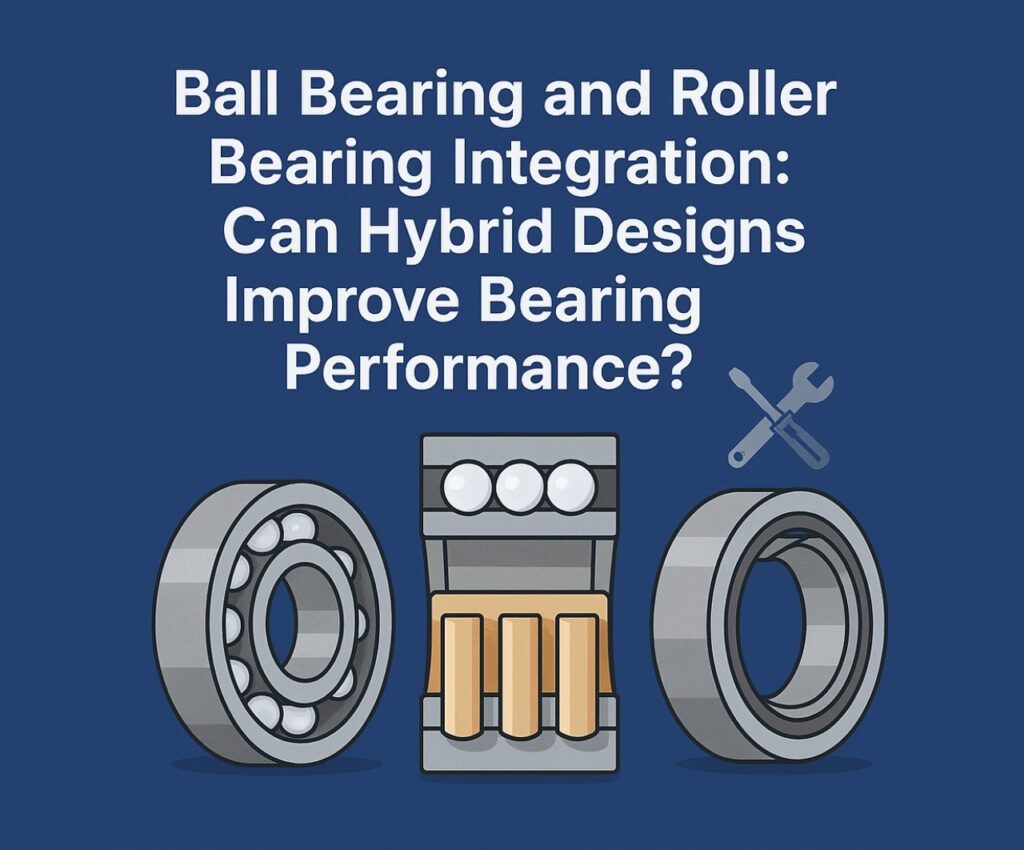
In today’s demanding industrial and automotive applications, engineers and OEM designers often face a performance tradeoff when selecting between a ball bearing or a roller bearing. But what if you didn’t have to choose? With advances in hybrid bearing technology, the integration of ball bearing and roller bearing elements into a single assembly is becoming an emerging solution for applications requiring both speed and load capacity. These new bearing roller bearing designs with Roller Bearing Integration are capturing the attention of designers seeking high-efficiency motion under challenging conditions.
In this article, we explore the future of hybrid bearings—how they work, what problems they solve, and whether integrating ball bearing and roller bearing systems is the next step in advanced bearing performance. Know More
Understanding the Basics: Ball Bearings vs. Roller Bearings
To appreciate hybrid technology, we first need to revisit the fundamentals.
Ball Bearings:
- Use spherical balls as rolling elements.
- Provide low friction, high-speed capability.
- Excellent for radial loads and moderate axial loads.
- Common in electric motors, precision instruments, and passenger vehicle wheels.
Roller Bearings:
- Use cylindrical, tapered, or spherical rollers.
- Offer greater contact surface (line contact) vs. balls (point contact).
- Handle higher radial loads and shock loads better than ball bearings.
- Used in conveyors, off-road equipment, trailers, and gearboxes.
The traditional choice between a roller bearing or ball bearing comes down to application demands: high speed and low load vs. high load and moderate speed. But as applications grow more complex, so must the solutions.
What Is a Hybrid Bearing Roller Bearing?
A bearing roller bearing hybrid typically refers to a bearing assembly that incorporates both ball and roller elements in a single raceway system. In some cases, hybrids also refer to materials—such as ceramic balls in steel races—but here we focus on mechanical design hybrids.
Common Hybrid Configurations:
- Ball-Roller Combo Bearings:
- Radial load handled by rollers.
- Axial load supported by balls.
- Ideal for rotating systems with combined load demands.
- Split-Duty Bearing Assemblies:
- Separate rows of balls and rollers.
- Can operate independently within the same housing.
- Often found in industrial gearbox applications.
- Segmented Bearings:
- Custom housings or cages that carry both element types.
- Tailored for complex load paths or directional forces.
Hybrid ball bearing and roller bearing designs are engineered to give you the best of both worlds—speed and strength in one integrated unit.
Advantages of Integrating Ball Bearing and Roller Bearing Elements
The benefits of hybrid bearing integration are particularly evident in advanced industrial or automotive environments where traditional bearings underperform or wear out prematurely.
1. Improved Load Handling
- Rollers support larger radial loads.
- Balls reduce axial stress and rotational resistance.
- The combined effect supports multi-axis loading with less deformation.
2. Enhanced Durability
- Hybrid systems distribute stress more evenly across the raceway.
- Less contact fatigue and spalling.
- Lower maintenance frequency.
3. Compact Design Solutions
- One hybrid bearing can replace two separate units (ball + roller).
- Space and weight savings critical in aerospace and robotics applications.
4. Reduced Friction and Heat
- Ball segments reduce rolling friction.
- Lower heat generation extends lubrication intervals and lifespan.
These benefits make ball bearing and roller bearing hybrids especially attractive for mission-critical components in wind turbines, aerospace controls, high-speed rail, and heavy-duty automation systems.
Ideal Applications for Bearing Roller Bearing Hybrids
Not all systems require hybridization—but when they do, performance gains can be significant. Below are scenarios where combining elements is most effective.
| Application | Why Hybrid Works |
| Electric vehicle drivetrains | High axial + radial loads; speed + torque requirements |
| Industrial gearboxes | Offset loads + harsh operating environments |
| Aerospace actuators | Weight savings + rotational precision |
| Robotic joints | Compact design with multiple directional forces |
| Wind turbine yaw systems | Slow-speed, high-load multidirectional movement |
In these environments, relying solely on a roller bearing or ball bearing often leads to compromises—hybrids can offer a balanced solution.
Design Considerations for Engineers
If you’re an OEM or engineer considering a hybrid solution, keep these points in mind:
1. Load Calculations
Hybrid bearings need precise modeling. Improper load assumptions can cause overloading of one rolling element type.
2. Lubrication Strategy
Ball and roller elements may require different lubrication viscosities or intervals. Engineers must account for this in maintenance schedules.
3. Housing and Fit Tolerances
Tighter tolerances are required in hybrid systems to ensure optimal load sharing and performance.
4. Cost vs. Lifecycle
Hybrid bearings cost more upfront than traditional options, but extended service life and better reliability often offset the premium.
Partnering with a supplier experienced in hybrid ball bearing and roller bearing solutions can ensure these factors are correctly addressed during design.
Material Advances in Hybrid Bearings
Material science is playing a major role in advancing hybrid bearing performance. Beyond geometry, hybrid systems are incorporating:
- Ceramic balls in steel roller bearings (lightweight, heat-resistant).
- Composite cages for lower inertia and wear.
- Corrosion-resistant races for marine or washdown environments.
- Self-lubricating seals to reduce friction and contamination.
These advancements are helping the bearing roller bearing hybrids reach new levels of speed, efficiency, and reliability.
Challenges and Limitations
While promising, hybrid bearings are not without tradeoffs:
- Complex Manufacturing: Producing multi-element raceways increases manufacturing difficulty and cost.
- Limited Off-the-Shelf Availability: Most hybrids are custom-engineered, which can extend lead times.
- System Compatibility: Integrating hybrids may require changes to shaft, housing, or support structures.
- Higher Initial Cost: Justified in performance-critical systems but may not suit budget-limited applications.
For now, hybrid ball bearing and roller bearing designs remain most feasible in OEM applications where long-term performance outweighs upfront costs.
The Future of Ball and Roller Bearing Technology
The next generation of bearing roller bearing systems will be smarter and more adaptive. Some trends to watch:
- Sensor-integrated bearings: For real-time monitoring of temperature, vibration, and load.
- AI-assisted predictive maintenance: Using big data from bearings in smart factories.
- Modular hybrid designs: Allowing serviceable segments (e.g., replace balls or rollers without full disassembly).
- Grease-free operation: Through advanced coatings and materials.
As machines get faster, smaller, and more powerful, the need for adaptive, multi-role bearings will only grow.
Final Thoughts: Is a Hybrid Right for You?
The question isn’t whether a roller bearing or ball bearing is better—it’s whether your application would benefit from a smart combination of both. In many industries, especially those undergoing rapid automation or weight reduction efforts, ball bearing and roller bearing integration is proving to be a breakthrough in both efficiency and reliability.
If you’re designing for mixed-load environments, confined spaces, or next-generation motion systems, hybrid bearings are worth strong consideration.
Looking for expert guidance or custom-engineered hybrid bearing solutions? As a trusted wholesale supplier, we offer both high-precision ball and roller bearings as well as consultation on hybrid bearing roller bearing integrations for OEM platforms. Contact our technical team today to explore how the right bearing design can transform your application. Know More