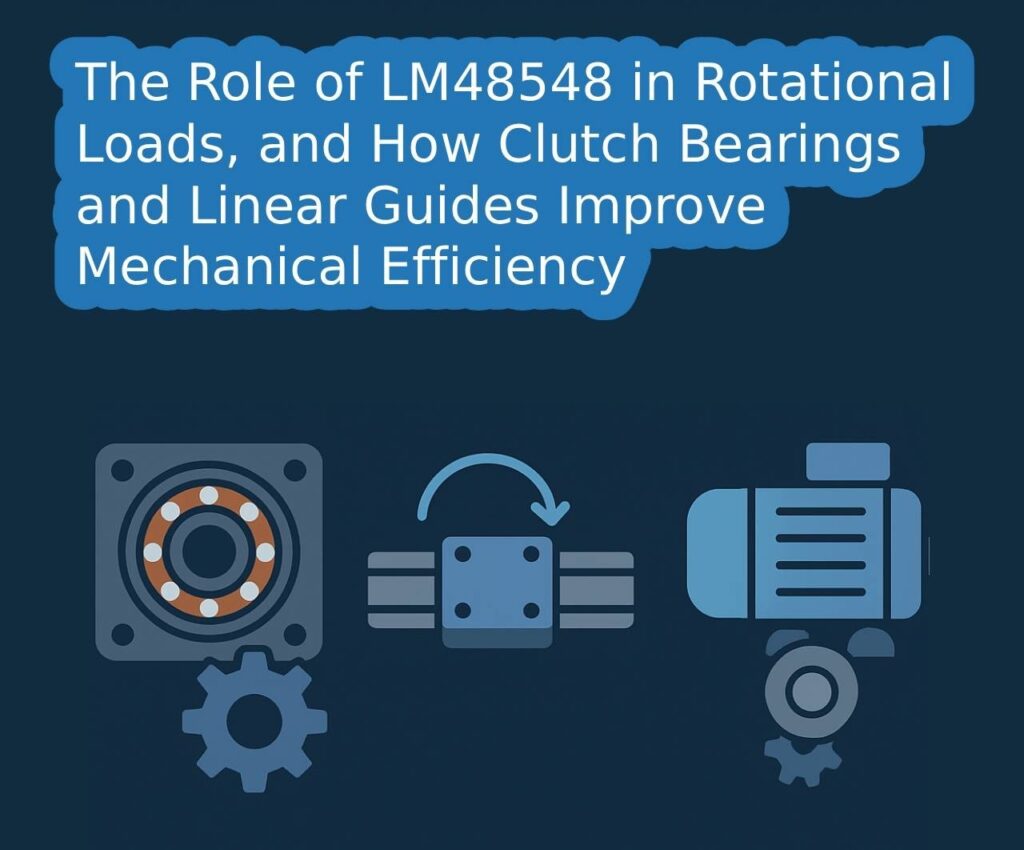
In today’s fast-paced manufacturing and equipment industries, component performance can define system longevity and operational efficiency. Whether you’re working on vehicle axles, agricultural equipment, or industrial automation, precision bearings are essential. Three components play a crucial role in mechanical motion systems—lm48548 bearing, bearing in clutch, and linear bearing guides. These elements, when selected and implemented correctly, ensure optimal load distribution, reduce friction, and increase the mechanical efficiency of rotating and linear motion systems.
In this article, we’ll explore the specific function of the lm48548 bearing in rotational systems, how a bearing in clutch systems improves torque transfer, and how linear bearing guides offer unmatched smoothness and alignment in automated motion. We’ll also discuss how these components intersect with key engineering principles such as load support, alignment, and friction reduction. Know More
Understanding Bearing Roles in Mechanical Load Systems
Before diving into individual components, it’s important to understand how bearings function at a fundamental level. Mechanical systems operate under three primary forces: radial load, axial load, and combined loads. Bearings are designed to resist these forces and allow for controlled, low-friction movement.
- Rotational Bearings (e.g., lm48548 bearing): Handle radial and thrust loads in rotating shafts and hubs.
- Clutch Bearings (e.g., throw-out bearings): Facilitate torque transfer between engine and transmission systems.
- Linear Guides (e.g., linear bearing guides): Support precision linear motion with minimal resistance.
Each plays a vital role in reducing energy loss, wear, and misalignment in mechanical systems.
Spotlight: LM48548 Bearing in Rotational Load Systems
The lm48548 bearing is a tapered roller bearing cone commonly used in automotive wheel hubs, trailer axles, and light-duty industrial equipment. It’s paired with a matching cup (typically LM48510) to form a high-performance bearing set.
Technical Specifications:
- Type: Tapered roller cone
- Bore Diameter: 1.3750″ (34.93mm)
- Load Capacity: High radial + moderate axial loads
- Material: High-carbon chromium steel
- Applications: Trailer hubs, agricultural equipment, automotive axles
Engineering Advantages:
- The tapered geometry of the lm48548 bearing allows it to manage both axial and radial loads simultaneously.
- Its design reduces stress on the shaft by evenly distributing load across the rollers.
- Perfect for high-load, low-speed applications—such as trailer wheel hubs and machinery pivot points.
Because of its efficient load-bearing capacity and compact footprint, the lm48548 bearing is a trusted solution across rugged terrain vehicles and off-road trailers where rotational stability is key.
The Role of Bearing in Clutch Assemblies
When discussing torque transfer and powertrain control, the bearing in clutch systems cannot be ignored. Commonly referred to as a clutch release bearing or throw-out bearing, this component facilitates the smooth engagement and disengagement of the clutch system in manual transmissions.
Why It Matters:
- Ensures proper alignment between the pressure plate and clutch disc.
- Allows friction plates to engage without vibration or drag.
- Reduces friction between the rotating clutch and the stationary actuation mechanism.
A faulty bearing in clutch assembly can lead to:
- Noise during gear shifts
- Clutch slippage or difficulty in disengagement
- Increased wear on the clutch fork and pressure plate
Engineering Consideration:
The bearing in clutch must handle high axial forces with minimal resistance. It must also operate smoothly under rapidly changing speeds and directional torque, which requires both high material strength and precise manufacturing tolerances.
OEM and aftermarket clutch systems often use sealed or self-lubricating clutch bearings to extend service intervals and improve thermal resistance in stop-and-go traffic or heavy-load scenarios.
Linear Bearing Guides: Precision in Motion
Unlike rotational bearings, linear bearing guides are designed to facilitate straight-line motion with high accuracy. These systems are crucial in automation, CNC machinery, and robotic arms where positional precision and repeatability are non-negotiable.
Key Features of Linear Bearing Guides:
- Low friction coefficient for smooth travel
- Load-bearing rollers or balls supported by precision-machined tracks
- Compact profile for space-limited designs
- Corrosion-resistant options for food, medical, or marine environments
Common Applications:
- CNC routers and laser cutters
- 3D printing machinery
- Packaging lines and robotic arms
- Semiconductor manufacturing
Why Engineers Prefer Linear Bearing Guides:
- They maintain a consistent centerline, reducing the need for frequent recalibration.
- Can bear loads in multiple directions, depending on guide type (ball-type vs. roller-type).
- With proper lubrication and dust protection, linear bearing guides offer excellent longevity and reliability.
The synergy of these guides with actuators and linear motors increases throughput in automated lines while maintaining safety and accuracy.
Load Dynamics: Comparing All Three Components
| Component | Type | Load Type | Motion Type | Best Use Case |
| LM48548 Bearing | Tapered roller cone | Radial + Axial | Rotational | Trailer hubs, agricultural wheels |
| Bearing in Clutch | Axial thrust bearing | Axial | Rotational | Manual transmissions, heavy vehicles |
| Linear Bearing Guides | Ball or roller linear rail | Radial + Light Axial | Linear | Robotics, CNC machines, automation systems |
When designing a mechanical system, engineers must consider:
- Load direction and intensity
- Speed of operation
- Friction losses
- Environmental exposure (dust, moisture, temperature)
Each bearing type fulfills a specific requirement. For instance, the lm48548 bearing ensures rotational support in wheel systems, while the bearing in clutch optimizes torque conversion. Meanwhile, linear bearing guides provide low-resistance movement in positioning systems.
Material Science: What Makes These Bearings Durable?
Durability is dictated by both geometry and material properties. All three components benefit from advanced steel metallurgy:
Materials Commonly Used:
- SAE 52100 chrome steel: Used in lm48548 bearing and bearing in clutch due to its high hardness and fatigue strength.
- Stainless steel or anodized aluminum: Found in linear bearing guides where corrosion resistance is needed.
Surface Treatments:
- Heat treatment for surface hardening
- Anti-corrosive coatings
- Lubrication grooves and seals for dust/water exclusion
Engineers often specify sealed bearings or self-lubricating variants depending on application cycles and maintenance schedules.
Optimizing Mechanical Efficiency with Smart Bearing Selection
Tips for Engineers and Buyers:
- Use the lm48548 bearing when rotational durability and dual-load capacity are needed in compact hubs.
- Choose a premium bearing in clutch if high-speed disengagement under pressure is part of your system.
- Implement linear bearing guides in automated systems that require silent, low-friction linear motion with repeatability.
Common Errors to Avoid:
- Mismatching bearing load rating to system demands
- Overlooking lubrication schedules
- Ignoring alignment during installation
- Selecting bearings without environmental sealing
Bearings are not one-size-fits-all. Performance suffers significantly if components are not properly matched to the mechanical and environmental context.
Conclusion: Engineering with Purpose, Backed by Precision
Mechanical systems rely on precise components working in perfect harmony. The lm48548 bearing provides strong rotational load capacity for high-duty wheel hubs. The bearing in clutch allows for seamless torque transfer in manual transmissions, ensuring safety and drivability. And in the realm of automation and mechatronics, linear bearing guides offer unmatched smoothness, precision, and service life.
For OEMs, engineers, and industrial buyers, understanding how each bearing supports motion — whether rotational or linear — allows for better design, lower failure rates, and improved mechanical efficiency. Know More