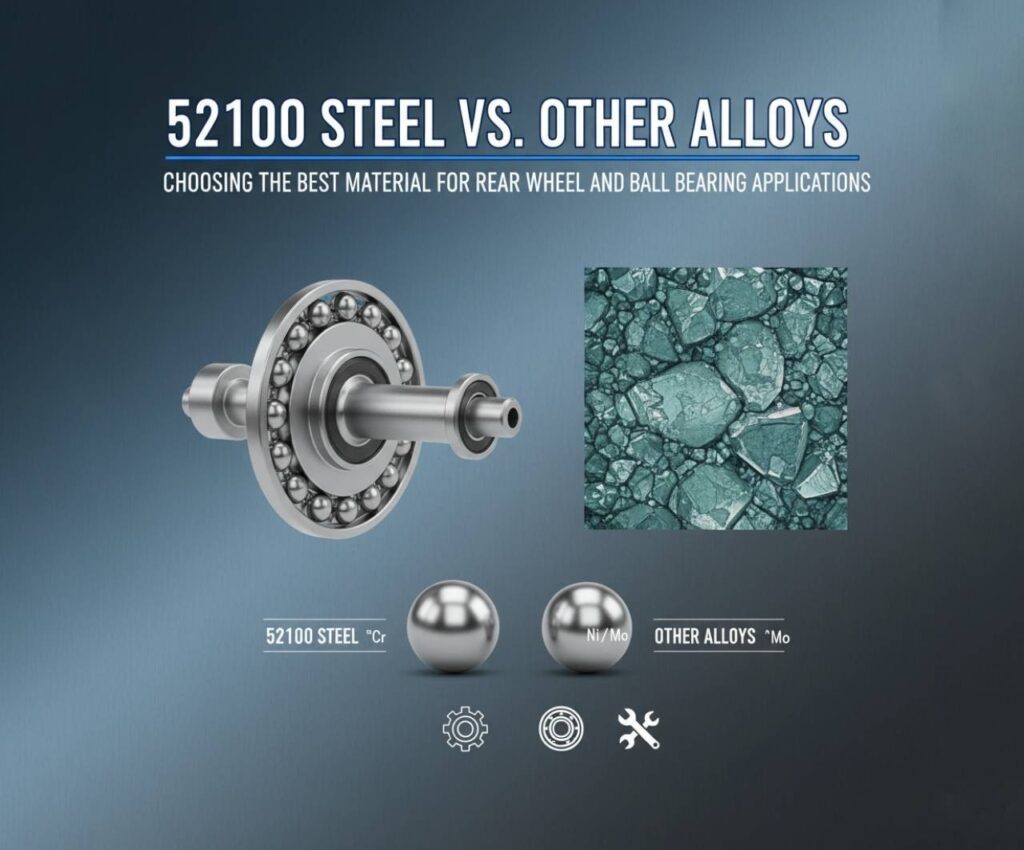
When it comes to building long-lasting, high-performance steel ball bearings and dependable rear wheel bearing assemblies, material selection is everything. Among the wide range of alloy options available, 52100 steel continues to dominate due to its excellent wear resistance, fatigue strength, and dimensional stability. But how does 52100 steel compare to other commonly used bearing materials like stainless steel, carbon steel, and ceramic hybrids? And how do these differences affect the performance of rear wheel bearing systems in real-world automotive and industrial environments?
In this article, we’ll break down the composition, advantages, and limitations of 52100 steel compared to alternative alloys, focusing on their suitability for steel ball bearings and high-load rear wheel bearing applications. If you’re an OEM, design engineer, or technical buyer looking for clarity in bearing material selection, this comprehensive guide will help you make the right choice. Know More
What Is 52100 Steel?
52100 steel is a high-carbon, chromium-containing alloy (1.00% C, 1.5% Cr) widely used in bearing manufacturing. Known for its exceptional hardness, strength, and fatigue resistance after heat treatment, it’s the material of choice for precision-engineered steel ball bearings used in automotive and industrial applications.
Key Properties:
- Hardness: Up to HRC 60–66 after heat treatment
- Tensile Strength: ~275 ksi (1896 MPa)
- Fatigue Strength: Excellent under cyclic loading
- Wear Resistance: High due to refined grain structure
- Machinability: Good when annealed
Because of these characteristics, 52100 steel is especially common in rear wheel bearing assemblies, where rotational stability, corrosion resistance (with proper coatings), and long-term load endurance are essential.
Steel Ball Bearings: Why Material Matters
Steel ball bearings play a vital role in reducing friction and enabling high-speed rotation under axial and radial loads. Whether in a high-RPM electric motor or the rear wheel bearing of a vehicle, the performance of the bearing largely depends on the balls’ material properties.
Why Choose 52100 Steel for Steel Ball Bearings?
- Dimensional Consistency: Less thermal expansion means better bearing clearances.
- Superior Surface Finish: Allows smoother rotation and reduced wear on raceways.
- High Compressive Strength: Withstands impact loads in off-road and heavy-duty vehicle use.
When you choose steel ball bearings made from 52100 steel, you’re investing in a product that will hold up under stress and extend service intervals—something critical for OEMs concerned with warranty claims and long-term customer satisfaction.
Rear Wheel Bearing Applications: Demanding Environments
A modern rear wheel bearing assembly must withstand variable torque, heat from braking systems, contaminants from the road, and dynamic axial/radial forces from turning and acceleration. It’s no surprise that 52100 steel is so commonly specified in these systems.
How 52100 Steel Performs in Rear Wheel Bearings:
- Fatigue Resistance: Resists spalling and surface fatigue over hundreds of thousands of cycles.
- Heat Tolerance: Retains hardness and shape under prolonged braking heat.
- Grease Compatibility: Works well with modern synthetic greases and sealants.
Rear wheel bearing failures are often due to substandard materials or improper sealing. Bearings made with 52100 steel offer excellent reliability when paired with dual-lip seals and proper lubrication.
Comparing 52100 Steel with Other Bearing Materials
Let’s examine how 52100 steel compares to common alternatives used in steel ball bearings and rear wheel bearing assemblies.
1. Stainless Steel (440C)
- Corrosion Resistance: High
- Hardness: Slightly lower than 52100 (HRC 58–60)
- Applications: Marine, food-grade, and medical
- Drawback: Lower fatigue life and load capacity
Verdict: Choose 440C for applications where corrosion is a primary concern. Otherwise, 52100 steel provides better overall bearing life and strength for rear wheel bearing use.
2. Carbon Steel (1045, 1060)
- Cost: Lower than 52100
- Hardness: Lower (HRC 45–50 range)
- Applications: Low-speed, low-load applications
- Drawback: Poor fatigue life and inconsistent heat treatment
Verdict: Avoid for automotive rear wheel bearing assemblies or steel ball bearings used in high-load conditions.
3. Ceramic Hybrids (Si3N4 balls with steel races)
- Friction: Extremely low
- Speed Ratings: Higher than 52100 steel
- Corrosion Resistance: Excellent
- Cost: Significantly higher
- Applications: Aerospace, racing, high-speed spindles
Verdict: While ceramic hybrids outperform 52100 steel in high-speed, precision applications, their cost and fragility make them impractical for general-purpose or rear wheel bearing use in most vehicles.
Advantages of 52100 Steel for OEMs and Engineers
Whether you’re manufacturing wheel hubs, gearboxes, or electric motors, 52100 steel offers several benefits that matter to OEMs and engineers alike.
1. Consistency
Its predictable heat treatment response and dimensional stability mean fewer rejects and easier integration into existing production lines.
2. Scalability
52100 steel is readily available worldwide, making it ideal for global supply chains and large-scale production runs.
3. Customizability
It can be precision-ground, coated, and modified to meet exact engineering tolerances—perfect for tight-clearance rear wheel bearing designs.
4. Proven Performance
Decades of usage in automotive and industrial settings validate 52100 steel as a proven material for high-performance steel ball bearings.
How to Spot High-Quality 52100 Bearings
Not all 52100 steel bearings are created equal. Low-cost imports may use recycled materials or skip essential steps like stress relieving or proper heat treatment.
Look for:
- Manufacturer certifications (ISO 9001, TS 16949)
- Full traceability reports
- Rockwell hardness data (HRC 60–66)
- Clean steel composition with minimal inclusions
Reliable steel ball bearings made from 52100 steel will come with dimensional charts, heat treatment specs, and load ratings—critical data for engineering teams.
Environmental Considerations and Coatings
Though 52100 steel offers excellent mechanical performance, it’s prone to corrosion if uncoated. That’s why many modern rear wheel bearing designs include:
- Zinc or phosphate coatings for corrosion resistance
- Labyrinth or dual-lip seals to keep contaminants out
- Synthetic greases rated for extended temperature ranges
These additions help extend service life in harsh climates and high-moisture areas—factors important for both passenger vehicles and industrial fleets.
Final Thoughts: 52100 Steel Is Still the Gold Standard
In an age where material science continues to evolve, 52100 steel remains the benchmark for steel ball bearings and rear wheel bearing assemblies. Its strength, fatigue resistance, and widespread availability make it ideal for high-load, high-speed applications across nearly every industry.
Whether you’re a design engineer specifying components for a new axle system or a purchasing manager looking for cost-effective, high-performance materials, 52100 steel offers the reliability you need—without compromise.
Looking for OEM-grade steel ball bearings and rear wheel assemblies made from certified 52100 steel? We stock a full range of precision bearings engineered for long life, high load, and peak efficiency. Contact us today for technical support, pricing, and bulk availability. Know More