
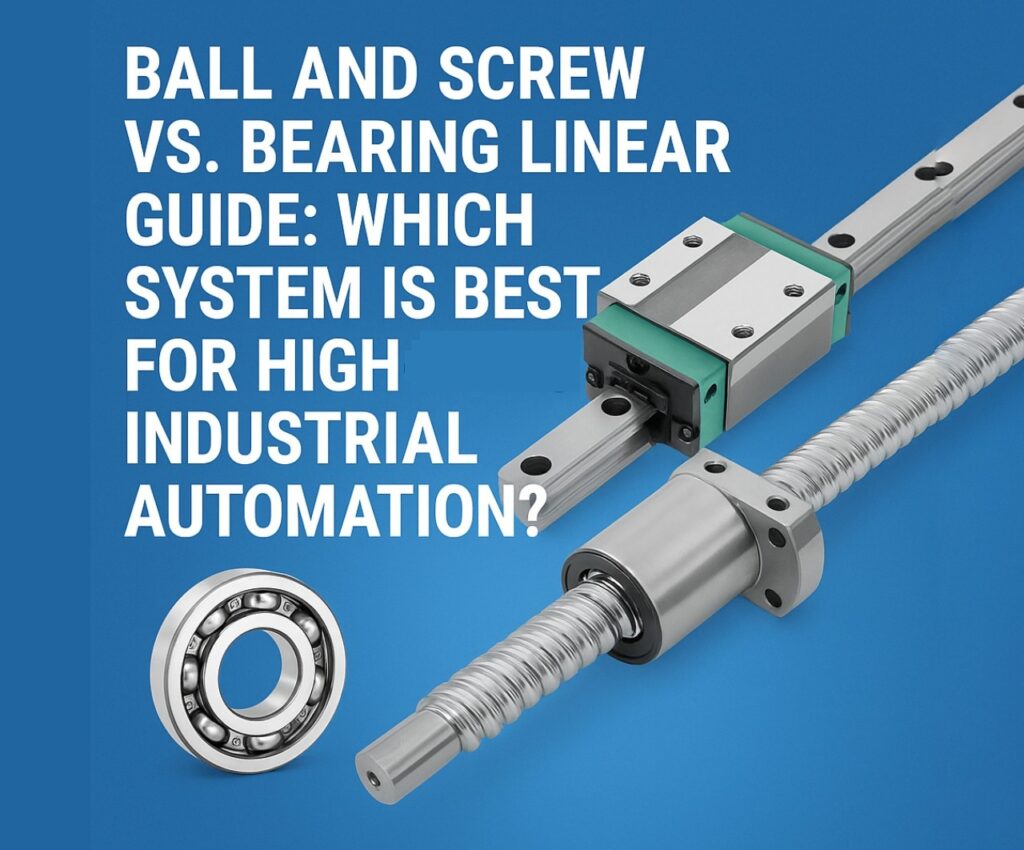
When designing industrial automation equipment, motion control precision is everything—and choosing the right linear system is a big part of that decision. Engineers are often faced with choosing between a ball and screw assembly or a bearing linear guide, depending on load, speed, and accuracy requirements. While both options have their place in motion architecture, understanding their unique capabilities helps avoid performance bottlenecks and system failures. Surprisingly, even a misunderstood component like a throw out bearing can help us explore the subtleties between friction handling and mechanical force translation in broader mechanical design.
In this guide, we compare the pros and cons of ball and screw mechanisms versus bearing linear guide systems—covering key engineering factors such as accuracy, load capacity, durability, maintenance, and ideal application environments. Whether you’re optimizing a CNC platform, designing a semiconductor fabrication tool, or building a precision packaging line, this breakdown will help you make the smartest, data-driven design choice. Know More
What Are Ball and Screw Assemblies?
A ball and screw system—commonly referred to as a ball screw—is a mechanical linear actuator that translates rotational motion to linear motion using a threaded shaft and a ball nut. Recirculating ball bearings between the nut and screw minimize friction and maximize efficiency.
Key Features:
- High mechanical efficiency (90%+)
- Tight lead and pitch tolerances
- Self-locking in some low-lead variants
- Ideal for long-travel linear motion
Ball screws are found in everything from 3D printers to aircraft flap actuators. Their ability to move loads with minimal friction and high precision makes them a staple in industrial machinery.
What Are Bearing Linear Guides?
A bearing linear guide is a system that enables smooth linear motion along a rail, supported by rolling elements such as ball or roller bearings. The carriage (or block) glides along the rail with extremely low resistance, often held in place using preload or magnetic force.
Key Features:
- Ultra-low friction
- High positioning repeatability
- Compact footprint
- Scalable for multi-axis systems
Bearing linear guide systems are commonly found in semiconductor automation, laser machines, and medical devices—anywhere micron-level repeatability is required in tight spaces.
Where Does a Throw Out Bearing Fit in This?
While a throw out bearing belongs to clutch actuation systems in vehicles, the way it manages axial load during rotational input highlights a design principle common in all linear systems: efficient force translation without compromising component longevity. In both ball and screw and bearing linear guide systems, minimizing frictional losses and ensuring smooth load transition are key to performance, just as they are in clutch systems.
Technical Comparison: Ball and Screw vs. Bearing Linear Guide
Let’s break down each category engineers and system designers should consider when selecting between these two systems.
1. Load Capacity
| Category | Ball and Screw | Bearing Linear Guide |
| Radial Loads | High (especially with larger screw diameters) | Moderate |
| Axial Loads | Excellent | Moderate to low |
| Shock Resistance | High (better energy dissipation) | Medium |
Verdict: For applications that involve pushing or pulling heavy loads over long distances, the ball and screw system wins.
2. Precision and Accuracy
| Category | Ball and Screw | Bearing Linear Guide |
| Positioning Accuracy | ±0.01–0.05 mm (typical) | ±0.001–0.01 mm (high-end models) |
| Repeatability | Good | Excellent |
| Backlash | Requires anti-backlash nut or preloaded assembly | Near-zero with preloaded guides |
Verdict: The bearing linear guide offers higher precision and lower backlash, ideal for applications like laser cutting or pick-and-place robots.
3. Speed and Acceleration
| Category | Ball and Screw | Bearing Linear Guide |
| Max Speed | Up to 2 m/s (depending on pitch and length) | Up to 5 m/s or more |
| Acceleration | Medium (load dependent) | High (lightweight carriages) |
Verdict: For high-speed or short-stroke repetitive applications, bearing linear guide systems deliver better acceleration and response.
4. Maintenance and Wear
| Category | Ball and Screw | Bearing Linear Guide |
| Lubrication Needs | Regular grease or oil required | Lubrication intervals vary; self-lubricating blocks available |
| Seal Sensitivity | Can degrade with dust or chips | Sealed options available |
| Component Replacement | Screw or nut may require full replacement | Rails and blocks are modular and easily swapped |
Verdict: Bearing linear guide systems generally offer longer intervals between maintenance, especially in clean environments.
5. Installation and Integration
| Category | Ball and Screw | Bearing Linear Guide |
| Mounting Complexity | Requires motor alignment, shaft support | Simpler; rails bolt directly to frame |
| Alignment Sensitivity | Critical—can cause wear if off-axis | High but forgiving with proper tolerances |
| Flexibility | Less modular; custom lengths needed | Highly modular and configurable |
Verdict: Bearing linear guide assemblies are easier to install and adjust, especially in modular machinery setups.
Ideal Use Cases: When to Choose Which System
Choose Ball and Screw When:
- Your system needs to carry heavy loads over long travel distances.
- You’re working in an environment where contamination (dust, chips) is expected.
- Precision is important, but not sub-micron critical.
- You want high thrust with efficient power conversion.
Examples:
- CNC routers
- Industrial lifting actuators
- Machine tools (X-Y-Z axes)
- Vertical screw presses
Choose Bearing Linear Guide When:
- You need extremely high positioning accuracy and repeatability.
- Your design calls for fast, smooth, and quiet motion.
- Weight or size constraints limit other options.
- You’re working in cleanrooms or enclosed automation lines.
Examples:
- Semiconductor and electronics assembly
- Medical imaging tables
- Robotic arms
- 3D printing gantries
Cost Considerations: What Delivers Better ROI?
Upfront, ball and screw assemblies can cost less per linear axis, especially in large-format machines. However, they may require more maintenance over time and carry higher energy loads due to friction.
Bearing linear guide systems have a higher upfront investment, particularly with premium rail and block configurations, but offer:
- Lower power consumption
- Reduced maintenance costs
- Fewer replacement cycles
ROI Tip: If your equipment runs continuously in a precision-driven environment, bearing linear guides can reduce downtime and operating costs over the machine’s lifecycle.
Hybrid Designs: Combining Ball Screws with Linear Guides
In many industrial systems, the optimal solution is not choosing one or the other—but combining both. It’s common to use:
- A ball screw for axial thrust,
- And a bearing linear guide for supporting lateral movement and carriage stability.
This hybrid layout is especially effective in CNC machines, medical imaging platforms, and automated packaging lines where both force and accuracy are critical.
Final Thoughts: Choose Based on Performance, Not Popularity
While both ball and screw and bearing linear guide systems are well-established, understanding their technical nuances empowers better design. There’s no universal winner—only what’s best for your application. By factoring in load, accuracy, environment, and maintenance goals, engineers can create motion systems that outperform expectations and extend equipment lifespan.
Looking for help choosing the right linear motion system? As a trusted OEM supplier, we offer wholesale pricing and expert support on high-precision ball screw assemblies, bearing linear guides, and even related components like throw out bearings for specialized motion applications.
Contact us today for selection guides, CAD models, and cross-reference support. Know More