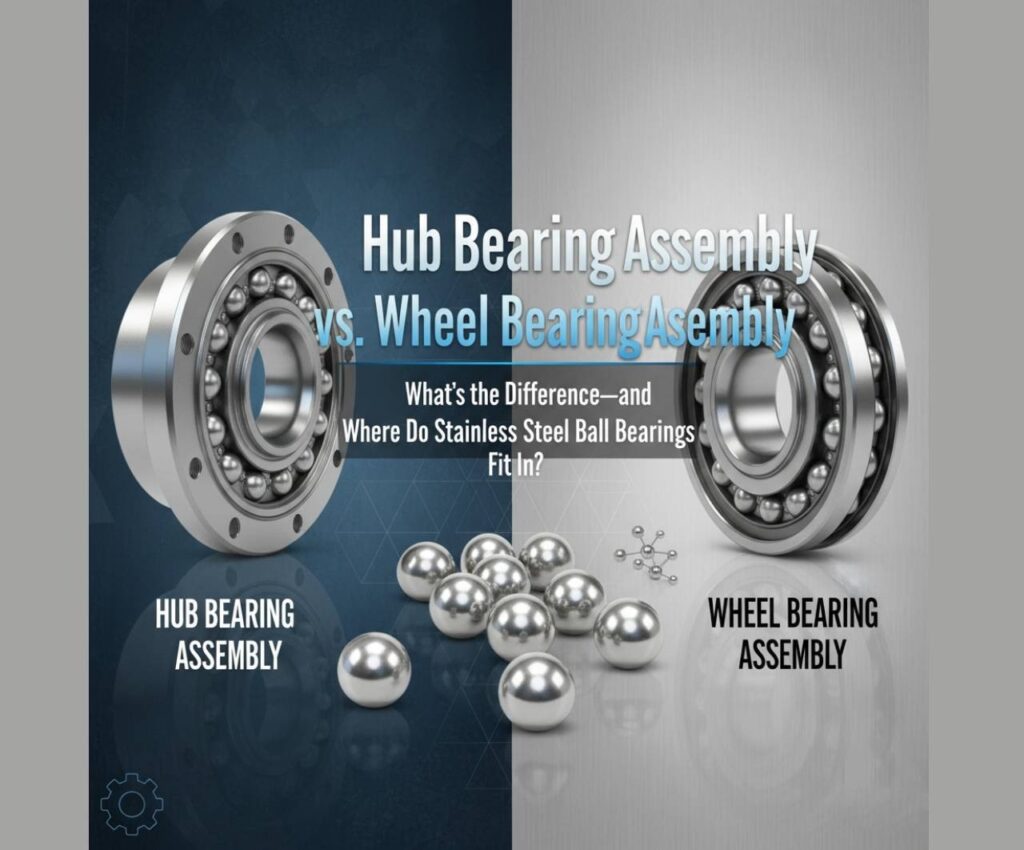
When it comes to precision movement, stability, and safety in automotive systems, choosing between a hub bearing assembly and a wheel bearing assembly can be more complex than it appears. Add the role of stainless steel ball bearings into the equation, and OEM buyers, mechanics, and engineers are often left wondering which configuration offers the best balance of performance, durability, and cost-efficiency. Whether you’re specifying components for light-duty sedans or heavy-load commercial vehicles, understanding the subtle—and not-so-subtle—differences between these components is critical.
In this guide, we’ll compare the functions, construction, materials, and use cases of both the hub bearing assembly and the wheel bearing assembly, and highlight where stainless steel ball bearings fit in. This is your go-to resource for making informed, spec-driven decisions that align with vehicle demands and long-term maintenance expectations. Know More
What Is a Wheel Bearing Assembly?
A wheel bearing assembly is a crucial component in the vehicle’s suspension system. It enables the wheel to spin freely with minimal friction and supports both axial (side-to-side) and radial (up-and-down) loads.
Key Characteristics:
- Composed of rollers or balls, inner and outer races, and seals
- Often press-fit into the wheel hub or knuckle
- Some require periodic lubrication and maintenance
- Available as serviceable or sealed units
Traditional wheel bearing assembly units have been widely used in older vehicles and are still common in some trucks, trailers, and off-road applications.
What Is a Hub Bearing Assembly?
The hub bearing assembly is the evolution of the traditional bearing unit. It includes the bearing, hub flange, ABS sensor (in most cases), and all necessary components in a single, sealed, preassembled module.
Key Characteristics:
- Sealed and maintenance-free
- Includes flange for direct mounting to the axle and brake rotor
- Designed for quick installation and replacement
- Common in front-wheel-drive and modern passenger vehicles
The hub bearing assembly offers a more compact, efficient solution, especially in high-speed and electronically integrated vehicle systems.
Comparative Breakdown: Hub Bearing Assembly vs. Wheel Bearing Assembly
| Feature | Hub Bearing Assembly | Wheel Bearing Assembly |
| Configuration | Integrated, sealed, and preassembled | Component-based; may be open or sealed |
| Maintenance | Maintenance-free | May require grease service |
| Installation | Bolt-on simplicity | Press-fit or race-in-hub required |
| Sensor Integration | Commonly includes ABS/traction sensor | Rare in older models |
| Cost | Higher upfront, lower labor cost | Lower part cost, higher labor |
| Durability | High, sealed against contamination | Depends on seal type and maintenance |
| Use Case | Modern vehicles, front/rear axles | Older models, trailers, heavy-duty trucks |
Understanding this comparison helps OEMs and service shops decide which type fits the target vehicle’s architecture and performance goals.
The Role of Stainless Steel Ball Bearings in Both Assemblies
Regardless of the assembly type, stainless steel ball bearings are essential to ensuring low-friction movement and corrosion resistance. While most automotive-grade bearings use chrome steel (52100) for hardness and fatigue strength, stainless steel ball bearings are increasingly found in specialized applications.
When Stainless Steel Ball Bearings Are Used:
- Marine environments (e.g., boat trailers)
- Electric vehicles (for better conductivity resistance)
- Corrosive or high-moisture environments
- Food-grade or medical transport vehicles
Although not as hard as traditional chrome steel balls, stainless steel ball bearings (usually made from AISI 440C) offer superior corrosion resistance and are ideal where frequent water exposure or chemical contamination is expected.
Material Science: Stainless Steel vs. Chrome Steel
| Property | Stainless Steel (440C) | Chrome Steel (52100) |
| Hardness | HRC 58–60 | HRC 60–66 |
| Corrosion Resistance | Excellent | Moderate (requires coatings) |
| Wear Resistance | Moderate | High |
| Cost | Higher | Lower |
| Best Use Case | Marine, food, medical | Automotive, industrial, heavy-duty |
For most hub bearing assembly or wheel bearing assembly systems in dry conditions, 52100 chrome steel remains the preferred choice due to its superior load-handling capabilities. But stainless steel ball bearings provide unique advantages in applications where exposure to salt, moisture, or chemicals is unavoidable.
Where Each Assembly Excels
Hub Bearing Assembly Advantages:
- Ideal for OEM mass production
- Reduces warranty claims due to sealed design
- Integrates sensors and electronics efficiently
- Easier for aftermarket service technicians
Wheel Bearing Assembly Advantages:
- Modular and customizable
- Easier to inspect and maintain (if serviceable)
- Better suited for agricultural or heavy off-road use
- Often compatible with stainless steel ball bearings in custom builds
OEMs designing for cost-sensitive markets may still use traditional wheel bearing assembly formats, especially where local service and repair expertise is high.
Installation and Maintenance Considerations
For Hub Bearing Assemblies:
- Requires torque precision during bolt installation
- Cannot be serviced; must be fully replaced when worn
- Pre-greased and sealed for life
For Wheel Bearing Assemblies:
- Requires press tools for installation and removal
- Serviceable bearings need regular inspection and re-greasing
- Offers the flexibility to upgrade to stainless steel ball bearings
In fleet maintenance environments, some prefer the modular approach of the traditional wheel bearing assembly, while consumer vehicles increasingly favor the sealed simplicity of the hub bearing assembly.
Common Failure Points to Watch
Regardless of assembly type, certain issues commonly lead to premature bearing failure:
- Contamination – Water or dust entering due to failed seals.
- Incorrect Installation – Over-torquing or misalignment.
- Bearing Fatigue – Caused by overloading or vibration.
- Material Degradation – Especially in corrosive environments where stainless steel ball bearings are recommended.
Proper part selection, installation tools, and supplier trust go a long way in avoiding these issues.
Choosing the Right Assembly for Your Application
As an OEM or mechanical engineer, the decision between hub bearing assembly and wheel bearing assembly should depend on:
- Vehicle class and load requirements
- Environmental exposure
- Sensor integration needs
- Maintenance accessibility
Likewise, when selecting bearing components or kits, consider whether stainless steel ball bearings offer added value based on use case.
Final Thoughts: Matching Assembly Type with Material Performance
Both hub bearing assembly and wheel bearing assembly systems play vital roles in automotive and industrial vehicle design. While hub assemblies offer a modern, maintenance-free solution ideal for high-speed, sensor-equipped vehicles, wheel bearing assemblies provide time-tested flexibility for high-load or service-intensive applications.
Meanwhile, stainless steel ball bearings are carving out a niche where corrosion resistance and precision movement are essential. For OEMs, engineers, and parts distributors, understanding where and when to deploy these components ensures smoother operation, longer lifespan, and better end-user satisfaction.
Looking for OEM-certified hub and wheel bearing solutions? We supply high-performance hub bearing assembly and wheel bearing assembly kits—available with chrome or stainless steel ball bearings for every environment and application. Contact us for cross-references, bulk pricing, and technical support tailored to your industry. Know More