
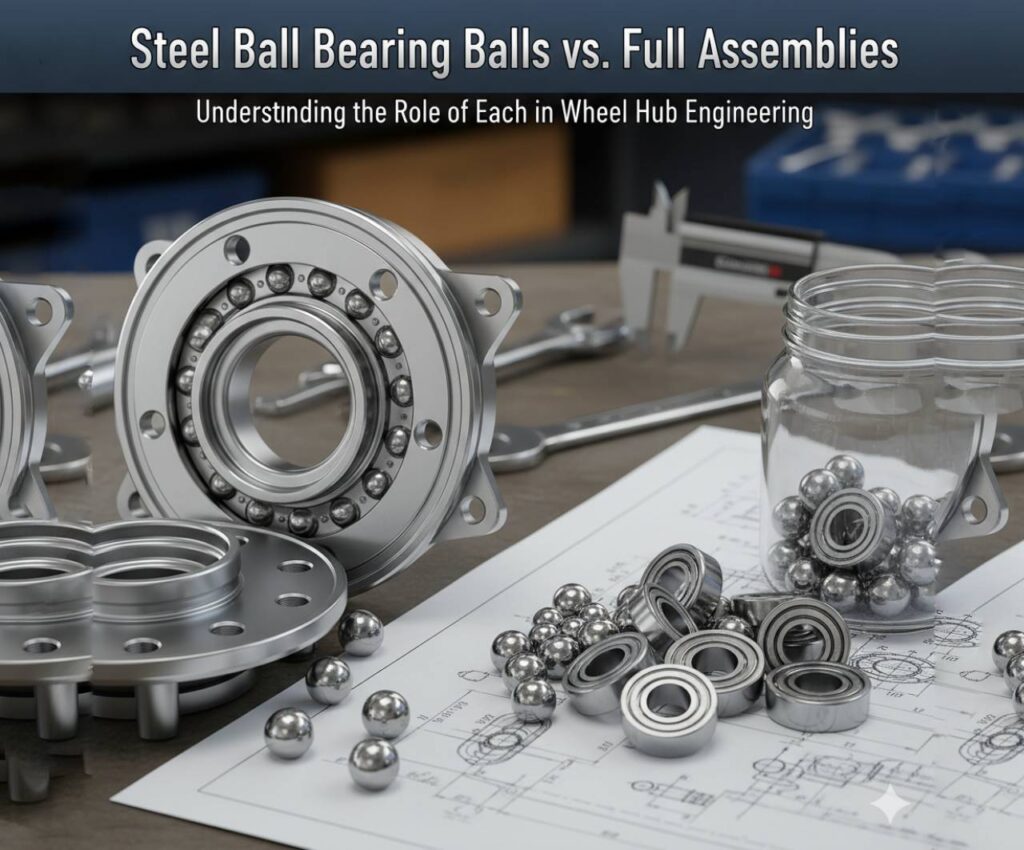
In the world of wheel hub design, precision matters—and so does the choice between sourcing individual components like steel ball bearing balls, or relying on complete wheel bearing and wheel hub assemblies. For OEMs and engineers, understanding where steel balls for ball bearings fit into the equation is key to designing reliable, high-performance systems that endure years of load, rotation, and environmental stress. Whether you’re building custom automotive platforms, high-load trailers, or electric drive systems, selecting between component-level control and drop-in assemblies can define the quality, cost, and longevity of your end product.
In this technical guide, we break down the functional and mechanical roles of steel ball bearing balls compared to integrated wheel bearing and wheel hub systems. Learn how each contributes to performance, when to choose one over the other, and why understanding both is essential in today’s engineering and procurement landscape. Know More
The Anatomy of a Wheel Hub: More Than Just a Bearing
At its core, a wheel hub is a mechanical unit that connects the wheel to the suspension and steering system, while enabling free rotation around the axle. Inside the hub lies the wheel bearing, which includes inner and outer races, cage, lubricant, and most critically—steel ball bearing balls.
Together, this unit must handle:
- Radial loads (vehicle weight)
- Axial loads (cornering and braking forces)
- Friction reduction
- Shock absorption
The wheel bearing and wheel hub system is responsible for smooth rotation, structural stability, and often includes ABS sensor integration. Whether you design or service hubs at the component level or deal in complete assemblies, understanding the role of steel balls for ball bearings is fundamental.
Steel Ball Bearing Balls: The Foundation of Precision Motion
Steel ball bearing balls are the rolling elements inside ball bearings. These precision-engineered spheres are typically made from high-carbon chromium steel (AISI 52100) and are designed to:
- Reduce rolling resistance
- Maintain consistent spacing via the bearing cage
- Carry heavy loads at high rotational speeds
Why Steel Balls Matter:
- Surface Finish: Superfinished to < 0.02 Ra for low friction
- Hardness: Heat-treated to HRC 60–66 for durability
- Sphericity: Maintained within microns for smooth operation
- Load Transfer: Provide point contact to minimize energy loss
In modern wheel bearing and wheel hub systems, steel balls for ball bearings are usually pre-installed in sealed units. However, engineers designing from scratch or customizing bearing systems for specific performance goals often start with sourcing the balls themselves.
Wheel Bearing and Wheel Hub Assemblies: Plug-and-Play Engineering
In contrast to working with individual components like steel ball bearing balls, most modern automotive and industrial platforms use integrated wheel bearing and wheel hub assemblies. These units arrive pre-assembled, sealed, and preloaded with factory-set tolerances and lubrication.
Advantages of Full Assemblies:
- Faster Installation: Bolt-on replacement, no press required
- Sealed for Life: No ongoing maintenance or repacking
- Reduced Assembly Time: Especially valuable in OEM lines
- Consistent Performance: Factory-calibrated tolerances
Full wheel bearing and wheel hub units are ideal for high-volume manufacturing, maintenance simplification, and tight system integration (e.g., ABS, traction control sensors). They’re used widely in passenger vehicles, SUVs, and trailers.
Comparing the Engineering Considerations
| Feature | Steel Ball Bearing Balls | Wheel Bearing and Wheel Hub Assemblies |
| Customization | High (ideal for tailored systems) | Low (pre-engineered to OEM spec) |
| Installation Complexity | High (requires cage, races, press-fit) | Low (bolt-on, preloaded) |
| Maintenance | Re-greasable (if in open bearings) | Maintenance-free |
| Sensor Integration | None directly | Common in ABS-equipped assemblies |
| Cost | Lower per unit | Higher per unit, but lower in labor |
| Typical Use Case | Custom hubs, low-speed/high-load applications | Passenger cars, trailers, light-duty trucks |
Choosing between steel balls for ball bearings and complete assemblies depends on application requirements, volume, load specs, and serviceability expectations.
When to Specify Steel Ball Bearing Balls
Best Use Cases:
- Custom-built wheel hubs for off-road or racing vehicles
- Heavy-duty industrial wheel carts or AGVs
- Trailer and utility hub retrofits
- Low-speed, high-load environments (e.g., agriculture)
Working at the component level with steel ball bearing balls allows engineers to select ball grade (precision tolerance), size, material coating, and hardness rating—tailoring the bearing to the exact application.
Key Specifications to Consider:
- Ball diameter: From 1 mm to 25 mm+ depending on load
- Material: Chrome steel vs. stainless steel vs. Ceramic
- Grade: Precision from G1000 (low) to G3 (ultra-high)
- Load rating: Based on number and diameter of balls
OEM designers focused on performance optimization or unique operating environments often prefer to build around individual steel balls for ball bearings.
When Full Assemblies Are the Better Choice
For most modern automotive applications, sealed wheel bearing and wheel hub units are the preferred standard.
Ideal For:
- Passenger vehicles and SUVs
- Fleet maintenance programs
- Manufacturers prioritizing production speed
- Tire & brake service shops
Sealed assemblies eliminate the need for technicians to deal with internal components like steel ball bearing balls, reducing human error and downtime. Their compact design also enables integration with onboard electronics and automated quality checks in manufacturing.
Common Pitfalls in Bearing Sourcing
Whether sourcing steel balls for ball bearings or full assemblies, mistakes can be costly. Here’s what to avoid:
- Low-grade steel balls: These lead to premature spalling and race damage.
- Inconsistent ball diameter: Causes vibration and uneven load distribution.
- Counterfeit full assemblies: Fake or non-certified hubs may fail under minimal stress.
- Overlooked preload specs: Incomplete or incorrect assembly can lead to rapid failure.
By working with trusted suppliers and ensuring quality standards (e.g., ISO 9001, ABEC, IATF), you reduce the risk of component-level failures that compromise the entire wheel hub and wheel bearing system.
Maintenance Considerations
- For steel ball-based systems: Bearings must be cleaned and re-lubricated at intervals—especially in exposed environments.
- For sealed assemblies: Visual inspection and early replacement are key. Once the seal is compromised, replacement is the only option.
No matter the system, watching for signs like humming, vibration, uneven tire wear, and excessive heat can indicate early-stage failure.
Sustainability and Lifecycle Design
Engineers increasingly factor sustainability into part selection. Choosing reusable bearings built around steel ball bearing balls allows:
- Repacking instead of replacing
- Material recycling
- Longer component life in low-speed systems
Meanwhile, sealed wheel bearing and wheel hub units offer lifecycle predictability and help reduce maintenance frequency—critical in large-scale fleet operations.
Final Thoughts: Knowing Both Is Better Engineering
In the debate between steel ball bearing balls and fully integrated wheel bearing and wheel hub assemblies, the correct answer isn’t one or the other—it’s knowing when to use each.
- Choose steel balls for ball bearings when customization, heavy load, or rebuildability is key.
- Choose wheel hub assemblies when speed, integration, and consistency matter most.
OEMs, engineers, and technicians who understand both options can design smarter systems, lower long-term costs, and deliver better performance. Know More